Built for Indian engineers interviewing at US tech companies.

You passed the
technical round.
You didn't get
the offer.

It wasn't your skills. It was how your skills came across — and that's a different problem with a different fix.

Indian professional culture and US hiring culture speak different languages. The behavioral round is where that gap decides the offer.

In a pool where everyone is technically strong, the behavioral round is the final gate. The engineers who clear it — and land the offer — are the ones who invested here.

Most spend months on LeetCode. Almost no one works on the communication patterns that decide the offer — and their starting salary.

Live translation — same project, same work
Dimension 2 of 6 — Quantified Impact
What you said "Worked on improving our CI/CD pipeline which made deployments faster and more reliable for the team."
What they heard "I can't tell if this was meaningful or minor. No numbers, no scale. Could be a one-line config change."
What the offer went to "I rebuilt the deployment pipeline. Release time dropped from 4 hours to 22 minutes. Team ships 3× more frequently now."

Neither answer is wrong. They're different professional languages. US behavioral interviews are calibrated for one of them.

What actually decides the offer

Same project. Two answers. One offer.

Dimension 5 of 6 — Bottom-Line-Up-Front Delivery
The engineer who didn't get it

"So there was a lot of context here — our team had been dealing with a legacy system for about two years, and leadership had been discussing a migration for a while. When I joined the project there were many stakeholders involved and we had to align across teams before we could even begin..."

8 years experience. Deep technical knowledge. Never got to the point.

↳ Debrief note: "Lost me in two sentences. Couldn't tell what they actually did."
The engineer who did

"I led the migration off our legacy monolith. Cut deployment failures by 80%. Delivered in 11 weeks while the team kept shipping."

Less senior. Fewer years. Got the offer.

The interviewer asked three follow-up questions. That's when you know it landed.

↳ Debrief note: "Crisp. Confident. Knows what matters. Strong hire."

"There were 12 of us in the final round at Walmart. We all passed the technical. Four got rejected in the behavioral. I was a little surprised as to why."

Software Engineer, Microsoft India

How it works

An AI interviewer that measures what you actually say — not what you planned to say.

You're interviewed by an AI voiced by Andrew — the founder, who spent 17 years as a hiring decision-maker in US tech, including as the final hiring authority over an Indian product and engineering entity. Not a synthetic voice. The actual person whose judgment this product is built on. He asks follow-up probes, pushes back on vague answers, and goes deeper when it needs to. Exactly what you'll face. After each 30-minute session, your answers are scored across 6 cultural dimensions and rewritten side by side — your words, then what a successful US candidate would say instead. Video sessions add a 7th dimension: how you show up on screen.

Step 1
The interview

An AI interviewer trained on US hiring expectations conducts a real 30-minute behavioral session. Asks follow-up probes. No scripts, no hints.

Step 2
The scoring

Every answer is scored across six dimensions: ownership language, quantified impact, STAR structure, conciseness, bottom-line delivery, and active voice. After your diagnostic, you'll have a baseline — a single number that tells you exactly where you stand, and moves as you train. Think of it like an athlete's sprint time. Audio sessions score all six. Video sessions add a seventh: how you show up on screen.

Calibrated across Amazon-style structured, open-ended, and unscripted formats. The gap shows up in all of them.

Step 3
The rewrite

Your exact answer, side by side with how a strong US candidate would say it — with every change annotated. Not a generic script. A rewrite of your specific words, your specific story, in the language that lands.

Step 4
Track your progress

Your baseline score is benchmarked against peers at your experience level. Run more sessions and watch it move. Dimension by dimension, you can see exactly what's improving and what still needs work — the same way an athlete tracks splits, not just finish times.

What your score looks like
Ownership language
3.8
US target: 7.5
Quantified impact
4.2
US target: 7.0
Bottom-line delivery
4.6
US target: 7.0

Synthetic example — illustrative of what Session 1 results look like. Your actual scores are based on your specific answers across all 6 dimensions.

What a rewrite looks like
Dimension 6 of 6 — Active Voice & Conciseness
Your answer

"The issue was identified by our team and a fix was implemented. The system was stabilized and the situation was resolved within the sprint. Feedback was positive from stakeholders."

Rewritten

"I identified a memory leak in the auth service, patched it in two days, and presented the fix to the VP of Engineering. Zero incidents since."

"Was identified by our team" → "I identified" — passive → active
"Feedback was positive" → "Zero incidents since" — vague approval → concrete result
52 words → 27 words — conciseness without losing substance
"The situation was resolved" → "patched it in two days" — vague closure → time-bound action

What "not the right fit" actually means

The feedback you got was probably wrong about why.

If you've walked out of a behavioral round thinking it went well — and then received "not the right fit" — it almost certainly wasn't about fit. US interviewers aren't evaluating your technical depth in behavioral rounds. They're listening for one thing: ownership.

Indian professional culture defaults to team framing. That's not wrong — it's a different professional language. US behavioral interviews are calibrated for the other one. Arpan teaches you to code-switch between both.

"Folks from India are brought up differently and the culture that you expect in US will be embodied best by people living in US. The expectation itself is a culture shift for us. In any case, we are always happy to understand newer ways to be. We prepare."

— Engineer, Rippling India

Same project  ·  Same work  ·  Different language  ·  Different outcome

The perception shift

American hiring managers don't hire the most technical candidate. They hire the candidate who makes them confident.

This is the thing most Indian engineers don't know going into a US behavioral round — and it changes everything once you do.

What most Indian engineers believe going in

"I cleared the technical rounds. The behavioral is just a formality. I'll handle it."

Technical strength is the bar. Behavioral feels secondary — softer, easier to fake. Most engineers treat it that way. The ones who don't are the ones who get the offer.

What US hiring managers are actually deciding

"Technical is the floor. Everyone who made it this far can code. I'm deciding who I can trust to own the work."

In a pool where everyone is technically strong, technical ability no longer differentiates. Communication and ownership are the hire signal.

The counterintuitive truth

A less experienced engineer who makes their work visible will get the offer over a more qualified candidate who can't.

Not sometimes. Most of the time. In a pool where everyone is technically strong, the hire signal is clarity — how quickly and confidently you can show what you did, why it mattered, and what you drove.

Dimension 1 of 6 — Ownership Language
Same engineer · Same work · Different language
Before

"We improved system performance significantly."

Debrief: "Team player. Unclear what this person personally did."

After

"I redesigned the caching layer. Query time dropped from 800ms to 120ms."

Debrief: "Clear ownership. Quantified impact. Strong hire."

Dimension 3 of 6 — STAR Structure
Same incident · Structured into a story that lands
Before

"So we had this situation where the system was degrading. The team investigated and after a few weeks we resolved it."

Debrief: "Vague. No actions, no outcome. Hard to evaluate."

After

"40% of API calls were timing out. I isolated the failure to a misconfigured connection pool. Fixed in 6 hours. Zero recurrence in 90 days."

Debrief: "Clear, structured, specific. Knows how to communicate under pressure."

The goal of Arpan is not to change who you are or how you think. It's to close the gap between what you actually did and what the interviewer is able to see. The work was always there. The language is what changes.

The rubric

Built by someone who made the final call — on both sides of the table.

Most interview advice comes from coaches who've studied interviews. Arpan's rubric was built by someone who spent 17 years as a hiring decision-maker in US tech — and who simultaneously ran an Indian product and engineering entity for a US startup. Both sides of the table, at the same time. That's not a credential. It's the only vantage point from which this rubric could exist.

High-growth startups

No published framework. Behavioral rounds are unstructured and ownership-heavy. Interviewers are looking for founders in engineer clothing — people who drive, not people who participate.

Growth-stage companies

Structured but not published. Competency frameworks exist internally — interviewers are trained to probe for individual impact, not team output. Collaborative answers read as low-agency.

Big tech

Principle-driven and structured. Amazon, Meta, and Google each have distinct behavioral formats. The gap is the same across all of them — only the scaffolding changes.

The 6 scoring dimensions
Ownership languageWE:I ratio, agency framing
Quantified impactmetrics, percentages, scope
STAR structuresituation, task, action, result
Bottom-line deliveryoutcome first, context second
Concisenesssignal-to-noise ratio per answer
Active voicepassive construction detection
Pro sessions add a 7th dimension: how you show up on screen.

"The rubric isn't based on what interview coaches say works. It's based on what I was actually evaluating when I made hiring decisions — and validated through direct conversations with Indian engineers at Meta, Google, Amazon, Goldman Sachs, Twilio, and others who've lived this gap firsthand."

— Andrew, Founder

Andrew with host mother in Kalimpong
With my host mother in Kalimpong, West Bengal — where my connection to India began, over 20 years ago.
Andrew with India team in Kerala
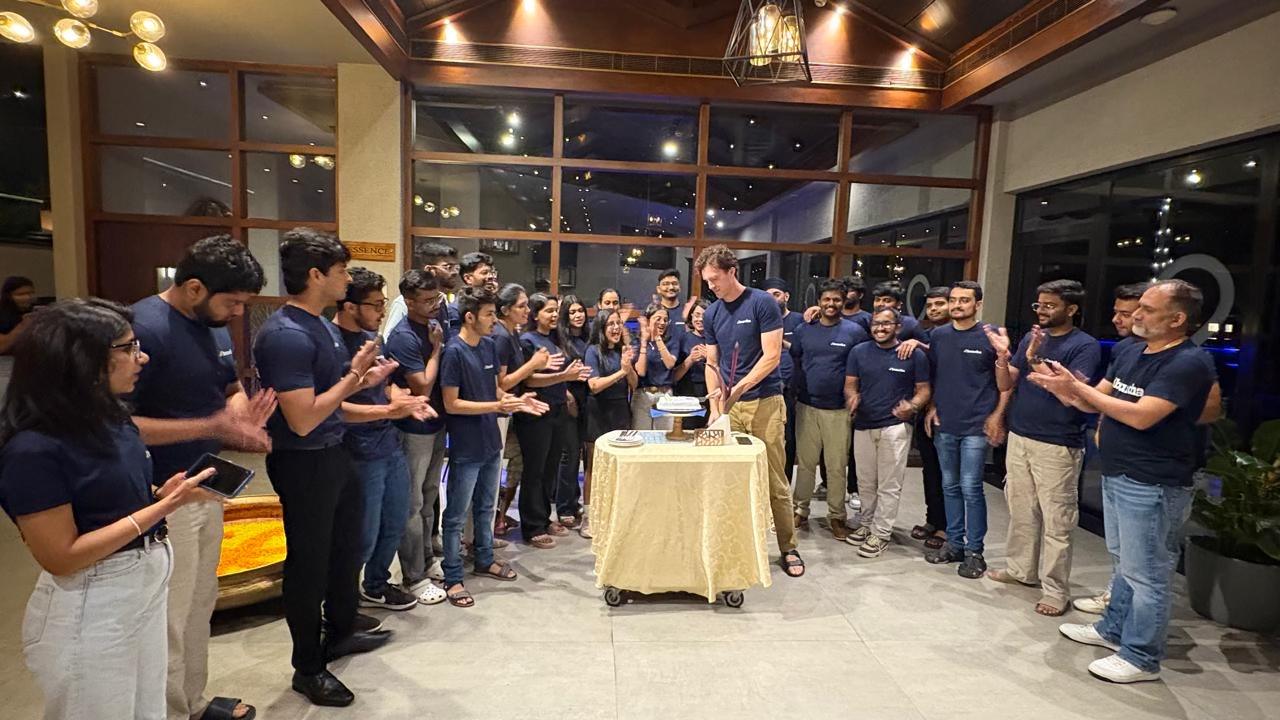
With the India team, Kerala — 2025. I've hired, managed, and interviewed engineers just like you for years. That's why I built Arpan.
🇺🇸
17 years as an operator in American tech
🇮🇳
6 months living in Kalimpong, West Bengal
🚗
Launched Uber Dallas
💼
COO & Head of Product, venture-backed startups
👥
Final hiring authority & manager, US Series A startup with Indian entity

Why this exists

I've been on the other side of this table.

I spent 17 years as an operator in American startups — including Uber and companies with successful exits. Throughout that career I worked with offshore and globally distributed engineering teams — at Neiman Marcus, at Minibar Delivery, and others. The deepest chapter came last: serving as final hiring authority and manager for an Indian product and engineering entity at a US startup, where I saw the gap from both sides at the same time.

"I'd read their résumé again. This person clearly did impressive work. But in the interview, I couldn't see it."

I spent six months living with a Brahmin Hindu family in Kalimpong — and have returned to India many times since, most recently working alongside the engineering team I managed. The family gave me the name Arpan — offering in Sanskrit. I understand why Indian engineers communicate the way they do. I also understand exactly what American interviewers are listening for, because I've been that interviewer — and the manager those engineers reported to.

Indian professional culture values team credit, thorough context, and collaborative framing. American interviewers expect individual ownership, bottom-line-up-front answers, and quantified impact. Neither is better. They're different professional languages. I've operated fluently in both. Arpan is the bridge.

Most interview coaching teaches you to memorize scripts in one of them. Arpan teaches you to switch registers — from the collaborative framing that works in Indian engineering culture, to the individual ownership framing that wins US behavioral interviews. So you can be who you are, in the language that lands.

And here's what most people miss: the interview is where this gap first matters, but it's not where it stops. In a market where technical skills are assumed, behavioral communication is how you differentiate — at the offer stage, in salary negotiations, and in every performance review and promotion conversation after you land. Master the language once. It compounds.

Why existing tools don't solve this

You've probably already tried the obvious things.

What they give you vs. what you need
LeetCode
Built for technical rounds. Has behavioral question lists on the side — community-sourced, generic, no scoring. Can't show you what you say automatically under pressure — and has no concept of the Indian-to-US communication gap.
Generic AI chatbots
A better answer when you ask for one. Can't show you what you say automatically under pressure.
Human mock interviews
One session with one person. No pattern tracking, no scoring, no rewrite. You get feedback on that answer — not insight into what you do every time.

None of them were built for this.

LeetCode's behavioral prep is community lists and generic STAR tips — built for anyone, calibrated for no one. AI chatbots are built for everything. Human mock interviews are one-off snapshots. None of them were built for one thing: the cultural communication gap that costs Indian engineers offers they've already earned.


The gap isn't in what you know to say. It's in what comes out automatically — under pressure, on the clock, when you're not monitoring yourself. You can't see that pattern by reading about it. You have to hear yourself.


You spent years mastering the technical side. The engineers who break through to US salaries treat the behavioral round the same way — as a skill that compounds. Not a box to check. A capability to build.

The Diagnostic

The only way to know your pattern is to hear yourself.

Two real behavioral interviews with an AI trained on US hiring expectations. Your own transcript, scored and rewritten. Most engineers are surprised by what they hear — not what they expected to fix.

2 real behavioral interviews, 30 minutes each
Scored across 6 cultural dimensions
Side-by-side rewrite of your actual answers
7-day access
The ROI framing

The behavioral round is not a formality. It is the round where Indian engineers — who pass technical screens at the same rate as anyone else — lose offers. Not because they lack capability. Because the communication style that works in Indian professional environments signals something different to US hiring managers.

Engineers who fix this don't just land offers — they negotiate from a position of demonstrated competence. The same patterns that win the behavioral round are what get you taken seriously in compensation conversations, performance reviews, and promotion decisions.

Begin your Diagnostic →